
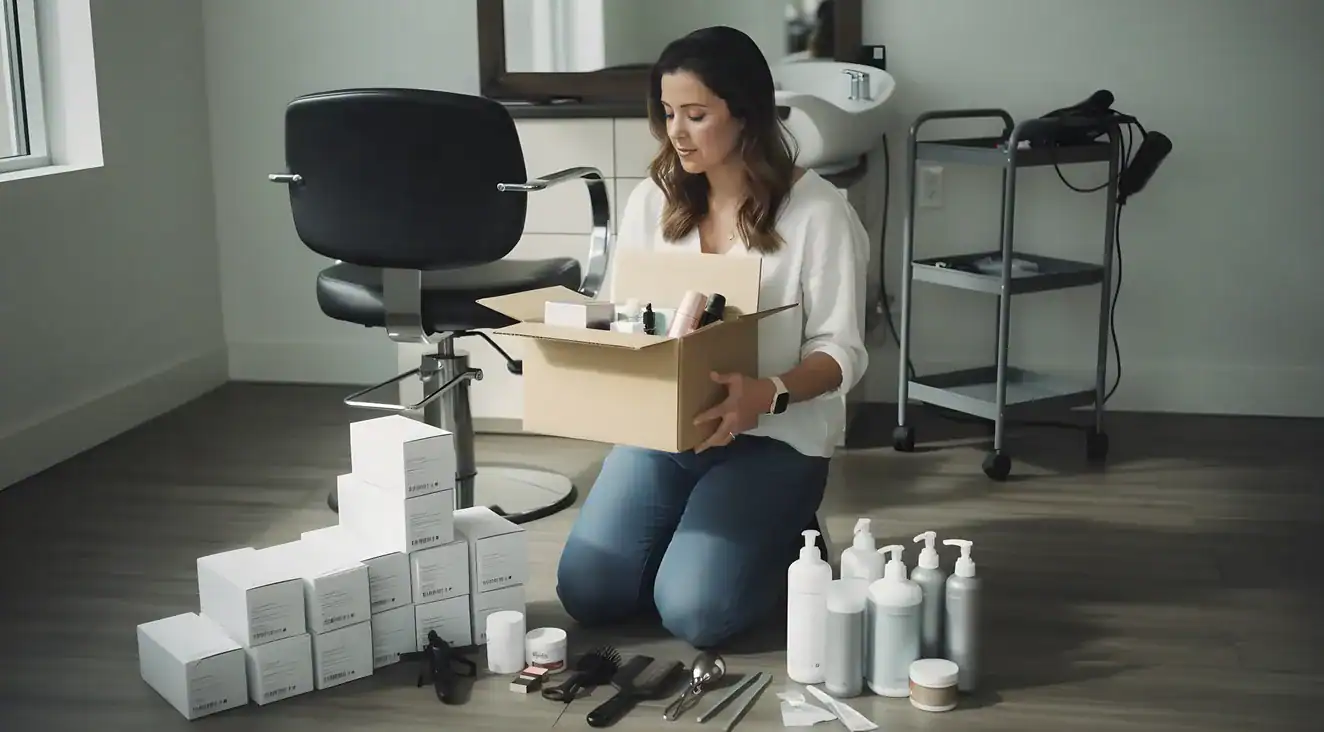
Opening a salon suite means signing a lease inside an existing gallery establishment as an independent beauty professional, not investing in a buildout. The cost to open a salon suite as a cosmetologist, esthetician, nail technician, barber, or licensed massage therapist breaks into two distinct budgets: a one-time startup budget that covers everything required before opening day, and an ongoing monthly operating budget that covers everything required to stay open. Conflating those two budgets is the most common financial mistake in year one.
The key startup cost categories are the security deposit, first month’s rent, discipline-specific equipment, initial product inventory, business formation fees, the Texas mini-salon license, and a marketing reserve. On the ongoing side: rent, professional liability insurance, general liability insurance, booking software, product restocking, and self-employment tax savings. Self-employment tax savings is consistently the most underfunded line item for professionals transitioning out of a commission arrangement.
Two factors that rarely appear in salon suite cost guides deserve early attention: the client transfer gap and the break-even client count. When a beauty professional moves locations, not all existing clients follow. Industry data puts the realistic transfer rate at 40-70%, and the financial ramp-up period at 60-180 days. A salon suite budget must account for that income dip rather than assume the full book transfers from day one. The break-even client count, the minimum number of appointments per month required to cover all fixed costs, tells you exactly how much business you need before the move makes financial sense.
For Texas beauty professionals, one additional startup line item applies: the Cosmetology Mini-Salon License issued by the Texas Department of Licensing and Regulation (TDLR), at a $70 non-refundable application fee.
Search the phrase “cost to open a salon suite” and most results target investors and franchise operators: buildout costs, leasehold improvements, franchise disclosure documents, and total investments in the $700K to $2M range. That content is not wrong. It answers a completely different question.
As a beauty professional, renting a salon suite means moving into a finished, furnished space inside a gallery and paying weekly or monthly for access to it. The gallery handles the buildout. The renter brings tools, clients, and all operating costs. A cosmetologist or nail technician evaluating a suite lease faces a startup picture that looks nothing like a franchise investor’s. This guide covers the renter’s version of the question: what cash do you need, in total, to open your doors and stay open through the first several months while your client book settles at the new location?
If you are researching the investor path, start with franchise disclosure documents from the major national gallery chains. That is outside the scope of this post.
The salon suite financial picture has two distinct layers. Confuse them and you will likely have enough cash to open but not enough to stay open.
Planning Note: The Working Capital Reserve
Three to six months of monthly fixed costs in reserve is the standard target before signing a salon suite lease. Six months is the safer figure. Three months is the floor, not the goal.
The reserve exists for one specific reason: monthly costs do not pause while the client book rebuilds after the move. Rent is due in full whether you are at 100% capacity or 50%. The reserve bridges that gap without forcing financial decisions from a cash-pressure position.
One-time startup costs are paid before or at opening and do not recur. They include the security deposit, first month’s rent, any equipment not provided by the suite, initial back-bar inventory, business formation costs (LLC filing, EIN registration, registered agent), the TDLR mini-salon license, and marketing setup. This is the cash that must be liquid before signing anything.
Ongoing monthly costs are fixed obligations that run every month regardless of client volume. Rent is the largest. Professional liability insurance, general liability insurance, booking software, product restocking, and self-employment tax savings are the others that consistently surprise professionals coming out of a commission arrangement. The critical point: ongoing costs do not pause while the client book rebuilds after the move. Month two is not discounted because the book is at 60% capacity.
This is why practitioners and industry resources consistently recommend holding a working capital reserve of three to six months of monthly fixed costs before signing a lease. Industry sources covering salon suite financial planning treat six months as the safer target. Three months is the floor. A reserve below that threshold means betting that the client transfer goes better than average, which is a bet worth examining before signing.
This post covers salon suite cost categories and a framework for estimating your own numbers, not specific dollar figures for Parker Salons suites. Suite rates vary by market, suite size, included amenities, and lease length. Quoting a universal number would be misleading. To get accurate figures for Plano, schedule a tour with Parker Salons directly.
The upfront cash requirement for a salon suite is larger than most beauty professionals expect, because the security deposit, first rent payment, and one-time setup costs all arrive at the same moment.
Security deposits at most gallery establishments run one to two months of rent, held against lease obligations. This is cash, not a fee. The deposit is returned at lease end, assuming the suite is left in good condition. But it is not available as operating capital during the tenancy, which means the full deposit amount sits outside the salon suite budget from day one. Most galleries require the deposit at or before lease signing.
First month’s rent is also typically due at signing or move-in. Depending on the gallery establishment, there may be additional move-in fees, access card deposits, or administrative onboarding costs. These do not always appear on the published rate card. Ask about them explicitly before the lease conversation advances.
The accurate way to picture total opening-day cash requirements: security deposit plus first month’s rent plus estimated one-time setup costs plus the working capital reserve. That combined figure is the cash to have liquid before signing anything. Get the specifics on deposit terms and any additional fees from the gallery directly.
What the gallery establishment provides determines a substantial portion of the one-time startup budget. The answer varies by gallery, by suite tier, and sometimes by negotiation.
Most hair suites include the physical space plus some combination of a styling chair, mirror, shampoo bowl or backbar access, and shelving. Esthetic suites may or may not include a facial bed. Massage suites may or may not include a treatment table. Nail suites in some galleries have existing ventilation infrastructure; in others, the nail technician is responsible for providing it.
What renters typically bring regardless of discipline: personal tools, back-bar inventory, any specialty equipment specific to their scope of practice, and all technology (booking software, payment processing, client communications). Decor and branding elements are also the renter’s responsibility.
The first question before signing any salon suite lease: “What exactly does this suite include?” That answer changes the startup cost estimate significantly, which is why the best next step is to schedule a tour at Parker Salons in Plano and ask exactly what each suite includes before finalizing any numbers.
Beyond the deposit and first month’s rent, these are the costs paid once to become operational.
Equipment and tools not included with the suite. Startup equipment costs vary more by discipline than by any other factor. Hair stylists need cutting and styling tools, color bowls, brushes, foils, and any specialty equipment for their service menu. Nail technicians need a manicure table, UV nail lamp, e-file, and sanitation equipment. Estheticians who are not provided a facial bed must budget for one, along with any advanced treatment devices within their scope of practice. Licensed massage therapists need a treatment table: portable options run roughly $250 to $3,000 depending on type and quality. Barbers should confirm whether the suite includes a hydraulic barber chair or a standard cosmetology chair, since a professional-grade hydraulic barber chair runs $800 to $3,000. Permanent makeup and microblading artists carry the highest equipment burden across all disciplines, because their scope requires a full sterile-field setup and, in some cases, autoclave equipment.
Initial back-bar and product inventory. A salon suite requires enough product to service clients from day one. Color-heavy hair practices require a significantly larger opening inventory than nail or massage services. Budget this line item based on the specific service menu, not a generic industry estimate.
Business formation costs. LLC or sole proprietorship filing, EIN if operating as an entity, business bank account, and registered agent if applicable. These are one-time costs. Current Texas filing fees are published at the Secretary of State’s website.
Marketing setup. Professional photos, a booking link or website, and pre-opening client communications all belong in the startup budget. A skilled professional in an unmarketed suite waits on clients who do not know they exist. Plan this investment before opening, not after.
TDLR mini-salon license. Covered in its own section below. Flag it as a separate line item in the startup budget.
| Discipline | Suite Often Includes | Key Equipment You Bring | Notable Variable |
|---|---|---|---|
| Hair Stylist | Chair, mirror, shampoo bowl | Cutting/styling tools, color supplies | Color back-bar inventory for colorists |
| Esthetician | Varies (ask before signing) | Facial bed (if not provided), treatment devices | Advanced device cost varies by scope |
| Nail Technician | Varies | Manicure table, UV lamp, e-file, ventilation | Ventilation requirement (confirm with gallery) |
| Licensed Massage Therapist | Varies | Treatment table ($250-$3,000), linens, oils | Linen management is an ongoing cost |
| Barber | Varies | Clippers, trimmers, barber chair if not included | Hydraulic chair: $800-$3,000 |
| PMU / Microblading Artist | Rarely provided | Full sterile-field setup, machine, pigments | Training cost $2,000-$8,000; higher insurance tier required |
These are the recurring costs that run regardless of client volume. Know each one before signing.
Rent. The largest monthly line item in any salon suite budget. The headline rate is not always the complete picture: some suites include utilities, Wi-Fi, and laundry in the monthly rent while others bill those separately. A suite that looks cheaper per month may cost more once utilities and laundry are added. Ask what is and is not included in the monthly rate. For Plano-specific figures, see the pricing note above.
Professional liability insurance and general liability insurance. As an independent operator, no employer provides liability coverage on your behalf. Professional liability insurance covers claims arising from service outcomes: chemical reactions, disputed results, and bodily injury from a service. General liability insurance covers property damage and third-party injuries in the suite. Some gallery establishments require proof of both policies at lease signing. Insurance carriers specializing in beauty professionals offer entry-level individual policies that can start under $100 per year at the base tier, with more comprehensive coverage available at higher tiers.
Booking software and payment processing. Most individual-operator booking plans fall in the $24-$30 per month range. Payment processing fees on transactions run 1.19% to 3.5% depending on the platform. At significant monthly volume, processing fees can exceed the software subscription cost. Compare both when evaluating platforms.
Product restocking. Restocking is an ongoing cost, not a one-time purchase. Color-heavy hair practices may spend several hundred dollars per month on product alone. Nail and esthetics work carry similarly high consumable spend relative to service price.
Self-employment tax. This is the line item that most consistently catches professionals transitioning out of a commission salon arrangement by surprise. As an independent operator, self-employment tax alone runs 15.3% of net earnings (12.4% Social Security plus 2.9% Medicare), per IRS Schedule SE, before federal income tax brackets apply. Industry practitioners consistently recommend setting aside 25-30% of gross revenue to cover the combined self-employment and federal income tax obligation. Quarterly estimated tax payments are required by the IRS. Waiting until April to address the tax bill is not a viable strategy.
Marketing spend. Marketing is an ongoing cost, not a one-time setup item. Even professionals with a strong existing client book need a retention and referral budget once operating independently in a suite.
Moving into a salon suite does not mean the full existing client book follows. This is not pessimism. It is the expected scenario, and the salon suite startup budget must account for it.
Pro Tip: Budget for the Transfer Rate, Not the Full Book
Build your salon suite budget around 40-50% of your current client volume, not 100%. If more clients follow you in month one, that is a surplus, not the baseline. If fewer follow, you are not behind.
Two actions that consistently move the transfer rate toward the higher end of the 40-70% range: giving clients as much advance notice as possible before the move, and making sure your booking history (names, contact info, service records) lives in your own system rather than the previous salon's software.
Industry sources covering the transition to independent operation cite 40-70% as the realistic client transfer rate: the share of current clients who will follow a beauty professional to a new independent location within the first year. The range is wide because it depends on the length of the client relationship, how much booking history lives in the professional’s own contact records versus the previous salon’s system, and how proactively the move was communicated before opening day.
What this means practically: a hair stylist generating $4,000 per week at a commission salon should not build their suite budget around $4,000 per week from day one. Planning around the lower end of the transfer range and treating anything above that as a positive outcome is the financially sound approach.
The income recovery period runs 60-180 days for most beauty professionals, depending on pre-opening marketing activity and the quality of client communication in the weeks before the move. This is not an outlier outcome. It is what the research consistently documents.
Salon business coaches who write on the commission-to-independent transition note that stylists who make the move with the least financial stress are generating consistently over $100,000 per year in service revenue and have at least six months of expenses saved before opening. That is the benchmark to target in the salon suite financial planning process.
The working capital reserve recommended earlier (three to six months of monthly fixed costs) is specifically designed to bridge this gap. It provides the ramp period without forcing decisions from a cash-pressure position.
The break-even client count is the most important number to calculate before any salon suite lease conversation. It defines the minimum appointments per month required to cover every fixed operating cost. Below that threshold, the business spends down savings. Above it, the business generates income.
Quick Insight: Break-Even Is a Floor, Not a Target
Break-even means the business is no longer spending down savings. It does not mean the business is generating a livable income. A practical rule of thumb: livable income typically requires roughly twice the break-even client count.
Run the formula twice: once to find break-even, once to find the client count that produces the income you need. The gap between those two numbers is the growth target for year one.
Total monthly fixed costs is the figure built from the monthly operating cost section: rent, insurance, booking software, product restocking, and any other fixed line items. That total is the denominator. Accuracy here matters.
Average service revenue per appointment after product costs is what the professional actually retains per appointment before overhead, but after the cost of the products consumed in that service. This is an individual number, not an industry average. A hair colorist with a $180 average ticket after product costs and a nail technician with a $45 average ticket need completely different client volumes to reach the same break-even threshold.
Two benchmarks worth knowing when running this calculation: break-even is the floor of viability, not a revenue target, and livable income typically requires roughly twice the break-even client count. Additionally, rent as a share of gross revenue should not exceed 10-15%. If the break-even math shows rent consuming more than 15% of expected gross at a realistic client volume, that ratio deserves close attention before signing.
Running this formula with actual individual numbers, before walking into a lease conversation, shows whether the suite makes financial sense at the current client volume and average ticket, and what growth is required to make it work long-term.
Every beauty professional operating independently inside a gallery establishment in Texas requires a Cosmetology Mini-Salon License issued by the Texas Department of Licensing and Regulation. The application form is COS022. The application fee is $70, non-refundable.
Texas TDLR Mini-Salon License: Don't Miss This Step
Three separate credentials are required to operate legally as an independent beauty professional inside a Texas gallery establishment. Missing any one can delay your opening date or result in a compliance issue after opening.
Budget the $70 fee and allow processing time between application and approval when setting your opening date. The license renews on a biennial cycle; add the renewal fee as a recurring line item every two years.
This license is separate from the individual cosmetology, esthetics, barbering, or nail technician license issued to the professional. The gallery establishment holds its own separate establishment license for the building. The individual license covers the professional’s practice. The TDLR mini-salon license covers the suite as its own establishment. All three credentials are required to operate legally in Texas.
One important update: Texas revised its licensing rules in 2024 and eliminated the separate booth rental license requirement. Individual license holders can now rent booths and suites on their personal cosmetology, esthetics, or barbering license. The mini-salon license for the suite itself remains required. For beauty professionals who previously postponed going independent partly because of a confusing licensing stack, the current TDLR requirements are simpler than they were.
The mini-salon license renews on a biennial cycle, so add the renewal fee as a recurring budget item every two years. Check the current renewal fee at tdlr.texas.gov, since fees are updated periodically. Allow processing time between TDLR application and approval when planning the opening date.
Every beauty professional opening a suite at Parker Salons in Plano needs to include the TDLR COS022 application as a startup budget line item. Budget the $70 application fee and build the processing window into the timeline before the planned opening date.
Q: Do you need a business license to open a salon suite in Texas?
A: Two credentials are required beyond the individual cosmetology, esthetics, or barbering license. First, a Cosmetology Mini-Salon License from TDLR (form COS022, $70 application fee) for the suite itself as an establishment. Second, a local business registration if operating under a business name rather than a personal name. Local registration requirements vary by city and county in Texas. Contact the Texas Secretary of State’s office and the local municipality for current filing requirements before the planned opening date.
Q: What is a realistic expectation for how many clients will follow me to a new suite?
A: Industry sources covering the transition to independent operation consistently cite 40-70% of the existing book as the realistic client transfer rate in the first year. The range reflects the length of the client relationship, how much booking history the professional controls directly versus what was held in the previous salon’s system, and how clearly the move was communicated before opening day. Build the salon suite budget around the lower end of that range. Direct pre-opening communication with the client list tends to push the transfer rate toward the higher end.
Q: How long does it typically take to break even in a salon suite?
A: Break-even timing in a salon suite depends on fixed costs, average service ticket, and how quickly the client book stabilizes after the move. Industry research suggests suite renters typically reach break-even in two to four months, compared to six to eighteen months for professionals opening a salon from scratch. Running the break-even formula above with individual numbers produces a more accurate projection than any industry average.
Q: Do I need insurance to rent a salon suite?
A: Professional liability and general liability insurance are both worth budgeting for. Neither is provided by the gallery on the renter’s behalf. Some gallery establishments verify proof of both before allowing a renter to open. Entry-level individual policies from carriers who specialize in beauty professionals are available at accessible price points, with higher tiers offering broader coverage. Shopping for a policy before signing gives a realistic picture of what this line item adds to the monthly operating budget.
Q: How do salon suite costs in Plano compare to other Texas markets?
A: Suite rental rates in Plano and the North DFW corridor reflect a competitive, densely developed market in Collin County. National cost benchmarks drawn from smaller Texas cities or other states will not accurately represent what a beauty professional finds in Plano. For current Plano-specific figures, schedule a tour at Parker Salons. That conversation provides the actual numbers to plug into the break-even calculation.
If you are still working through whether a salon suite makes financial sense at your career stage, see Is a Salon Suite Worth It? for a closer look at the full income and lifestyle trade-offs involved in the transition.
The two-budget framework, the break-even formula, and the salon suite cost categories in this post provide the structure to run your own numbers. But the actual figures that go into that math depend on three things: what the suite includes, the lease terms, and the Plano market rate. None of those are knowable from a blog post.
Looking for salon suites in Plano? Call (469) 467-8081 or visit parkersalons.com.
The only way to fill in those variables accurately is to see the suites and ask the questions directly. What does the suite include? What are the deposit terms? What is in the monthly rate and what is not?
Tour Parker Salons in Plano, see exactly what each suite includes, and get the real numbers. Then run the break-even math.