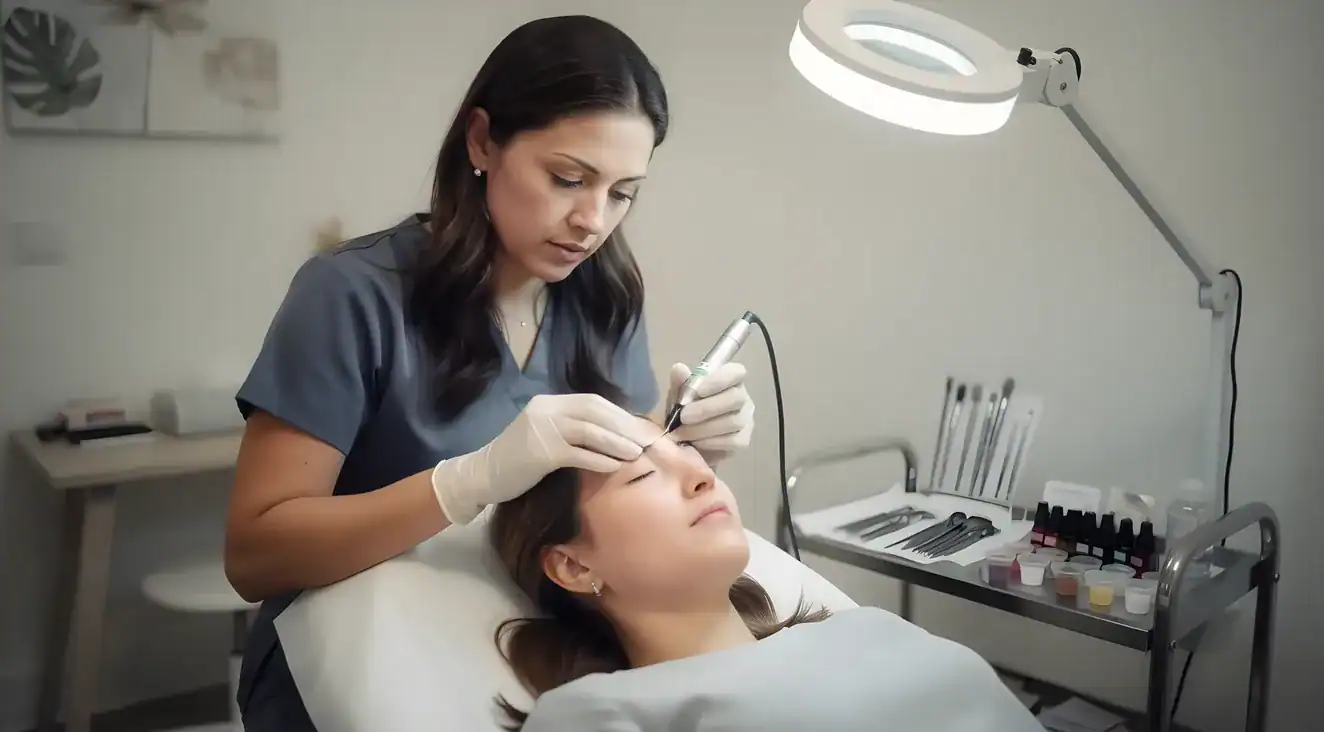
Running a permanent makeup business as an independent PMU artist comes down to four things being in place before you take your first paying client: a compliant space with a current DSHS studio permit, a current bloodborne pathogens certification, a legal business entity, and a portfolio of documented healed results. In Texas, permanent makeup falls under the same regulatory framework as tattooing. The Texas Department of State Health Services licenses the studio address, not the individual artist. A private salon suite in a commercially zoned building satisfies the facility requirements at lower overhead than a full commercial build-out. The early months are front-loaded with effort. PMU artists who make it through that phase are the ones who build the client book before they lock in fixed overhead.
Texas treats permanent makeup, microblading, ombre powder brows, nano brows, lip blushing, eyeliner tattooing, and all other intradermal pigment procedures the same way it treats tattooing. The governing statute is Texas Health and Safety Code Chapter 146, administered by the Texas Department of State Health Services (DSHS). This trips up a lot of PMU artists who have heard that TDLR (Texas Department of Licensing and Regulation) oversees their work. TDLR governs cosmetology and esthetics. It does not govern permanent makeup procedures. Any online guide that says otherwise is wrong, and following that guidance will leave you with the wrong license.
Texas PMU Is Regulated by DSHS, Not TDLR
Most online guides for Texas PMU artists incorrectly name TDLR (Texas Department of Licensing and Regulation) as the governing body. TDLR oversees cosmetology and esthetics. It does not govern permanent makeup. Permanent makeup falls under Texas Health and Safety Code Chapter 146, administered by the Texas Department of State Health Services (DSHS). Relying on the wrong guidance leaves you applying for the wrong permit at the wrong agency.
The most important distinction in the Texas framework: the state licenses the facility, not the person. There is no individual artist license for PMU at the state level. The DSHS tattoo studio permit is tied to a physical address. A permanent makeup artist operating in a salon suite is, from DSHS’s perspective, operating a tattoo studio at that address and must hold a permit for that specific suite.
Before applying for the studio permit, you will need to confirm zoning with the property. DSHS requires a zoning verification letter from the city or county confirming that tattooing and permanent cosmetics are a permitted use at the studio address. Most guides skip this step entirely. For artists renting suites in Plano or anywhere in Collin County, this means asking building management directly whether tattooing and PMU are permitted uses under the commercial zoning before you sign anything. Discovering a zoning conflict after signing a lease is a significant problem.
The facility inspection that comes with the permit application looks for:
Beyond the facility requirements, all PMU artists working in a licensed studio must hold a current bloodborne pathogens (BBP) certification meeting OSHA Standard 29 CFR 1910.1030 and Texas Administrative Code Section 229.405(i). The certification must be renewed every year. Hepatitis B vaccination (or a signed declination) is also required. DSHS requires a permanent record for each client and each procedure performed, so consent forms and client recordkeeping are built into the compliance requirements from day one, not an afterthought.
One more point: DSHS administers the state floor. The City of Plano and Collin County may have additional requirements beyond what state rules specify. Verify with the City of Plano health department before opening day. Verify current permit fees and application requirements directly at dshs.texas.gov, as fee amounts change.
The short answer to “can you do PMU in a salon suite?” is yes, with the right setup. The longer answer is that a permanent makeup studio has more specific infrastructure requirements than most other beauty suites, and those requirements need to be confirmed before you commit to a space.
Ask Building Management These Questions Before You Sign
Confirm the following before committing to any suite lease for PMU work:
The non-negotiable starting point is the sanitation station. You need a dedicated sink with hot and cold running water, dispensable antibacterial soap, and a paper towel dispenser. The sink must be accessible from the treatment room so that proper handwashing does not require crossing the procedure area. This is a DSHS requirement, not a preference, and it rules out suites where a shared sink is the only option or where plumbing access is inadequate.
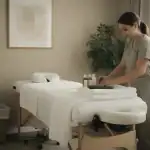
The treatment surface and client bed matter more than they do in a haircut suite. PMU clients recline during brow procedures (microblading, nano brows, ombre powder brows), eyeliner tattooing, and lip blushing work. A standard salon chair does not work well. A reclining treatment bed with non-porous upholstery, or barrier-protected upholstery cleaned with germicidal disinfectant between clients, is the standard setup. All hard work surfaces need to be non-porous and cleanable with a germicidal solution.
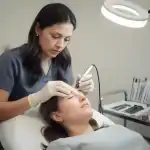
Lighting for permanent makeup work requires accurate color discrimination for pigment selection and enough precision to work on fine detail. Task lighting in the daylight color temperature range (approximately 5000K) with a high color rendering index (CRI) is the professional standard for PMU work. An adjustable-arm examination light positioned to illuminate the face without shadows is what most permanent makeup artists use. A window provides a useful secondary check for color accuracy in natural light, but it cannot replace consistent task lighting for the actual procedure.
Needle cartridges and sharps disposal require a specific plan. All used needles go into FDA-cleared, rigid, puncture-proof biohazard containers labeled as infectious waste. When the container is full, disposal must go through a licensed medical waste disposal company. Before signing a suite lease, ask building management two questions: Can I establish a sharps disposal contract for this specific suite? Is there an existing building arrangement for medical waste disposal that I can use? The answer determines whether this is straightforward or something you need to set up independently.
Ventilation matters in a closed suite, particularly for procedures involving topical numbing agents. Standard commercial buildings should provide adequate air circulation, but it is worth confirming before committing to a small, closed room.
The four non-negotiables for any permanent makeup studio suite: the dedicated sink, the task lighting for precision pigment work, the sharps disposal plan, and the reclining treatment bed. Everything else scales from there, but a suite without all four is either non-compliant or impractical for PMU work.
The portfolio comes before the suite, not after it. This is the part most early-independence timelines get backwards. A PMU artist who signs a lease before they have documented healed results is paying fixed overhead while trying to build the asset that drives bookings. Build the portfolio first.
Build Your Portfolio of Healed Results Before Signing a Lease
Healed photos are what book appointments, not fresh day-one results. Prospective PMU clients compare artists based on how the work looks four to six weeks after the procedure, when pigment has softened and settled. Sign a lease only after you have documented healed results across multiple techniques and skin types. Paying fixed monthly overhead while waiting for that portfolio to develop adds financial pressure to an already demanding early phase.
The reason healed results matter more than fresh photos is straightforward. Fresh permanent makeup looks significantly darker and more exaggerated than the healed outcome. Brows darken and appear sharper in the days immediately after the procedure. By week four to six, the skin has healed and the pigment has softened to its actual healed color. Prospective clients comparing permanent makeup artists online are looking at healed work. A portfolio that shows only day-one results can actively discourage bookings, because it does not represent what the client will actually look like after healing.
A strong PMU portfolio includes:
A private suite is a genuine client experience advantage for permanent makeup work. PMU consultations are personal. Clients are discussing features they feel self-conscious about, describing the appearance they want to correct, and often dealing with an “ugly phase” during healing when the brows or lips are still processing. None of that is easy in an open salon environment where anyone can overhear or observe. A private treatment room shifts the dynamic: it becomes a clinical consultation, and clients respond to that with more trust and more honest communication about what they want. Higher trust leads to better healed results and stronger referrals.
For discovery, visual platforms are where permanent makeup clients find artists. A consistent posting cadence of healed results (not just fresh procedures) builds the social proof that turns a follower into a booked appointment. Educational content about the healing process and technique differences between microblading and nano brows, for example, gives potential clients the context to make confident decisions. Set up your Google Business Profile before your first paid appointment, not after you have been open for a month. Clients who are actively searching for a permanent makeup artist near them in Plano or the broader DFW area are looking at local search results. Being absent from that channel during your opening weeks is time and bookings you cannot recover.
The best moment to ask for a referral is at the touch-up session. The client is seeing their final healed results for the first time in the controlled setting of your suite. Their satisfaction is at its peak. That is when you ask. PMU results are visible on the client’s face every day, and friends ask about them. Happy clients are strong referrers if you prompt the conversation at the right moment.
The touch-up cadence also structures your recurring revenue. Most initial permanent makeup procedures include a perfecting appointment at four to eight weeks, typically bundled into the base price. Annual or biannual color refresh sessions are the recurring revenue component that compounds as your client base grows. Build that expectation into the client relationship from the first consultation.
If you have not formed a legal entity, you are operating as a sole proprietor by default. That is not inherently wrong at the very beginning of your practice, but it does mean your personal assets have no separation from business liabilities. For a permanent makeup artist performing procedures with needles and topical numbing agents on clients’ faces, that exposure is real and specific. Adverse reactions, dissatisfied clients, and technique disputes are low-probability events individually, but over a career they are not zero.
An LLC (Limited Liability Company) separates personal assets from business claims. Formation in Texas goes through the Texas Secretary of State. You will also need a Federal Employer Identification Number (EIN) once you have a business entity in place, which is straightforward to obtain through the IRS. An LLC does not eliminate liability for professional negligence, but it does protect personal assets from general business disputes and client claims outside of proven negligence. For most independent PMU artists, forming an LLC makes sense once the permanent makeup business is generating consistent revenue and the financial exposure justifies the formation cost. A CPA or attorney can help you decide on the right timing for your situation.
Professional liability insurance covers claims arising from PMU procedures: adverse reactions, procedure dissatisfaction, harm claims. General liability covers property damage and bodily injury. Carrying both before you take paying clients is industry standard risk management for a procedure-based practice. This is not because any specific facility requires it. It is because you are performing a needle-based procedure on a client’s face, and the cost of an uninsured claim is substantially higher than the cost of the annual premium.
On pricing: permanent makeup pricing reflects technique complexity, your experience level, and the market you are working in. Initial procedures in the DFW market are typically structured to include the perfecting touch-up session in the base price, which sets the right client expectation from the start. Annual color refresh sessions are priced separately and become a predictable revenue line as your client base matures. Research what established permanent makeup artists in Plano and the broader DFW market are charging before setting your own rates.
The workspace decision is not just logistics. It determines your overhead structure, the client experience you can deliver, and whether you are on the right regulatory compliance path from day one.
Looking for private salon suites in Plano? Call (469) 467-8081 or visit the parkersalons.com contact page.
There are four realistic options for a permanent makeup artist going independent in Texas, and each carries a different profile of risk and compliance complexity.
Home studio: Eliminated before you even price it. DSHS requires a permanent makeup studio to be in a permanent, non-dwelling commercial building that is appropriately zoned. A home-based studio cannot qualify for a Texas tattoo studio permit. This is not a grey area.
Open salon booth: Low cost, but structurally incompatible with PMU work for two reasons. First, an open floor does not support the clinical consultation environment that permanent makeup clients expect and that drives repeat bookings and referrals. Second, a booth in an existing salon typically cannot support the dedicated sink access, sharps disposal arrangement, and treatment room setup that DSHS compliance requires.
Full commercial lease: Maximum control, but the overhead and build-out capital required are the highest-risk match for a PMU artist in the first one to two years when the client book is still growing. Signing a long-term commercial lease before you have consistent bookings is the most common financial pressure point in early PMU independence.
Private salon suite: Commercially zoned (which satisfies the DSHS non-dwelling building requirement), private treatment room for clinical consultations, lower overhead than a full commercial lease, and no build-out capital required. Building maintenance is managed by the facility. You are operating in a professionally maintained commercial environment with the per-client privacy that permanent makeup work benefits from.
The suite model is the practical entry point for a permanent makeup artist going independent in Texas specifically because it hits the regulatory floor (commercial zoning, DSHS-compliant building type), supports the client experience that justifies higher pricing, and does not require you to fund a commercial build-out before you know your first-year booking volume.
Parker Salons offers salon suites in Plano designed for appointment-based beauty professionals, including PMU artists who need a private, compliant workspace. The building is on W Parker Rd, centrally located in Plano for DFW-area clients.
No. Texas licenses the facility, not the person. The DSHS permit is issued to a specific studio address and must be renewed for each new location. Individual artists working in a licensed studio must hold a current bloodborne pathogens certification renewed annually and have Hepatitis B vaccination on file (or a signed declination). There is no state-issued personal practitioner license for PMU artists in Texas at the individual level.
No facility operator is required by law to mandate tenant insurance, and individual buildings have their own policies. Carrying professional liability coverage before seeing paying clients is standard practice in the permanent makeup industry because the work involves needles and topical numbing agents on clients’ faces. Most independent artists carry both general liability and professional liability to cover the full range of exposure.
Independent PMU artists earn through initial procedure fees, perfecting touch-up sessions (typically bundled into the base price), and recurring color refresh sessions every one to two years. The touch-up cadence is what creates compounding income over time as the client base grows. Early months are typically front-loaded with lower income while the portfolio builds. Artists in established markets like DFW tend to see income stabilize after 12 to 24 months of consistent bookings.
No. Under Texas Health and Safety Code Chapter 146, DSHS issues studio permits only to addresses in permanent, non-dwelling commercial buildings with appropriate zoning for tattooing. A residence does not qualify. PMU artists who want to work independently need a commercially zoned address, and a private salon suite in a compliant building satisfies that requirement.
Microblading uses a manual blade to create hair-stroke incisions in the skin. Nano brows use a PMU machine with a single fine needle cartridge that punctures rather than cuts. Nano brows have shown better pigment retention on oily and mature skin, which is why the technique has displaced manual microblading significantly over the past several years. A permanent makeup artist going independent today should have both techniques available for consultations, because skin type and client preference vary and a single-technique approach limits who you can serve well.
PMU clients refer others based on the visible healed results they wear every day. That makes word-of-mouth and referral the primary growth channel for a permanent makeup business, not volume. Artists who build durable practices do it through documented healed results, honest client relationships, and consistent investment in skill development. As technique continues to evolve (nano brows have substantially displaced manual microblading on oily and mature skin over the past few years, and machine-based shading has grown to represent a significant share of brow bookings at many established microblading studios), continuing education is what separates PMU artists who stay competitive from those who plateau on a technique they learned at their initial training.
What the CPCP Credential Actually Does for Your Bookings
The CPCP (Certified Permanent Cosmetic Professional) from the Society of Permanent Cosmetic Professionals and the comparable AAM credential are not required by Texas law. Their practical value is visibility: a prospective client researching PMU artists online sees a board-certified credential and has a faster path to deciding to book. The continuing education requirements built into renewal also keep your techniques current as the field evolves, which is not a minor point given how quickly nano brow machine work has displaced manual microblading in recent years.
For artists who want credentials beyond state compliance, the Society of Permanent Cosmetic Professionals (SPCP) offers the Certified Permanent Cosmetic Professional (CPCP) credential, which requires documented training hours, completed procedures, a current BBP certification, and a board exam. The American Academy of Micropigmentation (AAM) offers a parallel credential. Neither is required by Texas law, but both function as a client-facing trust signal: prospective clients who research their artist see a board-certified credential, and that visibility shortens the decision to book. The continuing education requirements built into renewal keep your skills current as techniques evolve.
Getting the foundational steps right from the start produces a specific, concrete result: you spend year one building your client base rather than correcting compliance gaps, redoing your studio setup, or unwinding a lease you signed before you understood the regulatory requirements. Most of the costly corrections in PMU independence happen when artists skip steps at the start. A compliant space, a documented portfolio of healed results, and a sound business structure mean your first year goes toward growth, not repair.