
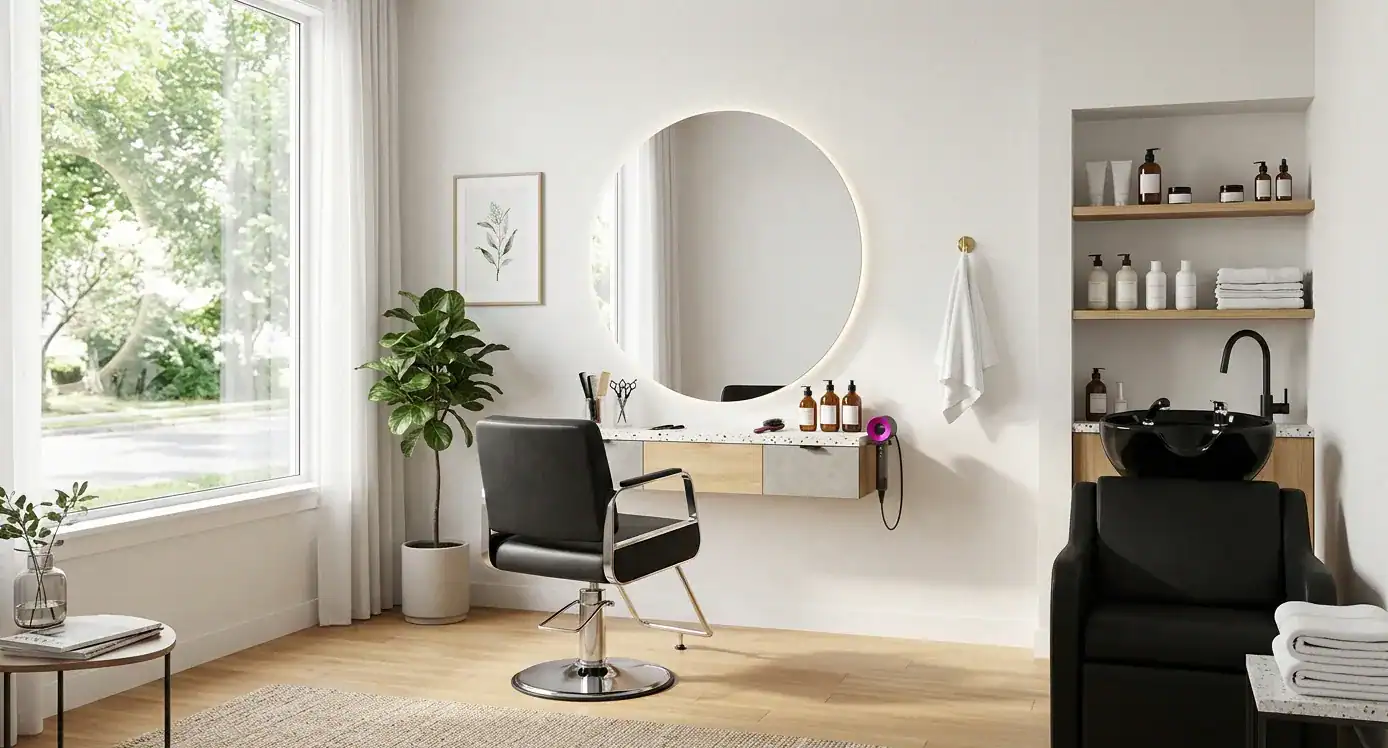
Most renters walk into a tour focused on the styling station and the rent number. Those are both important. But they are two of the easier things to evaluate. The seven things below are what most independent beauty professionals only learn about after they have already signed.
Choosing a salon suite involves more than picking a price and liking the lighting. It means reviewing a commercial lease agreement, calculating a realistic all-in monthly cost, physically inspecting the infrastructure, and asking questions most operators do not raise during a tour. Before comparing listings, independent beauty professionals should calculate the total monthly cost, including rent, utilities, insurance, and supplies. The base rent figure typically understates actual overhead by 40 to 60 percent. A salon suite lease is a commercial contract, and the details that matter most, including rent escalation caps, termination terms, and access restrictions, are rarely discussed on a tour. In Texas, the regulatory body for beauty professionals is the Texas Department of Licensing and Regulation (TDLR), and your licensing situation may affect which facility you can legally operate from. Standard suite sizes run 100 to 150 square feet for a single operator. The one question on your salon suite rental checklist that reveals more than almost any other: why did the last person leave?
Here are seven things to check before you sign.
The rent figure gets quoted. Everything else gets assumed.
Most salon suite listings quote a weekly or monthly base rate. What that number typically excludes: utilities (around $150 to $200 per month if billed separately), Wi-Fi ($35 to $75 per month at many locations), laundry access ($50 to $100 per month), and business insurance. General liability insurance and professional liability insurance together run $150 to $500 per month, depending on your services and the policy minimums your operator requires. The Associated Hair Professionals (AHP) standard requires $2 million per occurrence and $3 million annual aggregate coverage.
Then add supplies, roughly $800 to $1,200 per month for a full-time stylist covering color, shampoo, treatments, and retail inventory, along with marketing and booking software ($300 to $500 per month) and any Common Area Maintenance (CAM) fees the operator charges for shared building upkeep. CAM fees appear in commercial leases and are sometimes buried below the base rent line in the listing.
The 3x revenue rule: a sustainable salon suite business needs to generate at least three times the monthly suite rent in service revenue to cover all overhead and pay yourself a real income. If you pay $800 per month in rent, your revenue target is $2,400 per month before you are truly covering costs.
To convert weekly rent to monthly: multiply by 4.3, then add 30 to 40 percent for operating costs. That is your true break-even threshold.
Startup costs beyond the first month’s rent run $5,000 to $20,000 depending on how much equipment you own and how much you need to purchase. That range covers security deposit, initial product inventory, TDLR licensing fees, insurance setup, and basic marketing.
Tour question: “Can you give me a full itemized list of what is and is not included in the weekly or monthly rent, including any CAM or building fees?”
Red flag: Any operator who says “just the rent, nothing else” without a written amenities breakdown. Verbal assurances do not survive lease disputes.
| Typically Included | Typically Extra |
|---|---|
| Suite rent | Utilities (electric, water) |
| Use of your suite space | Wi-Fi |
| Building access | Laundry access |
| Shared waiting area | CAM fees |
| Basic common area maintenance | Professional liability insurance |
| Parking | General liability insurance |
📊 The 3x Revenue Rule A sustainable salon suite business needs to generate at least 3x the monthly rent in service revenue. If your rent is $800/month, your revenue target is $2,400/month before you are truly covering costs. Base rent typically understates total overhead by 40 to 60 percent once utilities, insurance, supplies, and marketing are added.
The physical inspection is where tours usually go shallow. Most operators show you the suite and tell you it is great. Here is what to actually test.
Plumbing. Run the shampoo bowl. Time how long hot water takes to arrive. Anything over 60 seconds is a problem you will deal with multiple times a day. Check whether there is a separate color mixing sink or whether you will be mixing in the shampoo basin. Test the drain.
Electrical. Count the outlets and note where they are positioned. Floor-level outlets create a daily frustration for anyone running multiple tools. Ask whether the suite has a dedicated 20-amp circuit for high-draw equipment. Running a dryer, flat iron, and steamer simultaneously on a shared 15-amp circuit trips breakers. Look for GFCI outlets near the sink. The National Electrical Code requires GFCI protection within 6 feet of water sources, so their absence is a code concern, not just an inconvenience.
Ventilation. This matters especially for nail techs, estheticians performing chemical peels, and stylists applying keratin treatments or relaxers. Ask whether the suite has a dedicated exhaust vent or shares an HVAC return with adjacent suites. Nail techs need source-capture ventilation at nail level, meaning an exhaust duct near the work surface, not a ceiling return that pulls fumes upward past your client’s face.
Lighting. Color temperature determines whether your color corrections are accurate. Below 3,500K (warm yellow light) makes it difficult to see what you are actually doing to a client’s hair. Daylight-range bulbs (5,000 to 6,500K) are the standard for color work. A window adds natural light that artificial sources cannot replicate for color appointments.
Soundproofing. Close the suite door and speak at a normal volume. Have someone stand in the hallway. What do they hear? For estheticians and lash artists whose clients expect privacy and quiet, paper-thin walls between neighboring tenants are a real service problem, not a minor annoyance.
Size benchmarks. 100 to 110 square feet is tight but workable for a solo hairstylist or esthetician with minimal equipment. 120 to 150 square feet accommodates a comfortable single-station setup. 150 to 200 square feet allows a second chair, a treatment table, or a part-time subletter arrangement.
Tour question: “Can I test the water pressure, check the hot water speed, and run the ventilation system during the tour?”
Red flag: A tour where you are not allowed to test anything, or where you are moved through quickly without time to inspect the infrastructure.
⚠️ Tour Red Flag If an operator rushes you through the tour or does not allow you to test the plumbing, check the outlets, or run the ventilation, that is information. A confident operator lets you inspect the infrastructure because they know it works.
A salon suite lease agreement is a commercial contract. “Standard” is a marketing word, not a legal one. Every clause is negotiable, and the clauses that create problems most often are the ones that sound routine.
Rent escalation clause. What is the annual cap? Three to five percent is typical for a well-run building. Some salon suite leases allow unlimited rent increases with 30 days’ notice. That is not a standard you should accept. On an $800 monthly lease, a 10 percent increase in year two adds $960 to your annual costs with almost no lead time to adjust your pricing or client volume.
Termination and exit penalty. Thirty days’ notice to vacate is reasonable. Sixty to 90 days is the outer limit of normal. If the lease requires you to pay the remaining balance on all months left in the term when you exit early, calculate your dollar exposure before you sign.
Subletting restriction. Can you rent your suite on your days off? Many salon suite leases prohibit subletting, which removes a natural way to offset rent costs through part-time arrangements.
Product and service autonomy. Some leases restrict which retail brands you may carry or set service pricing floors. Confirm you have full autonomy to set your own prices and stock your own shelves.
Build-out and modification rights. What can you change, and who owns those improvements when you leave?
Texas licensing note. In Texas, TDLR licenses both individual beauty professionals and the facilities they operate from. Individual renters may work under the facility’s operator license, or they may need to hold their own Cosmetology Mini-Salon License, depending on how the building is structured. Confirm which applies to your situation before you sign. Documents typically required to rent a salon suite in Texas include: a government-issued ID, your active TDLR cosmetology license, a certificate of insurance naming the operator as additional insured, and a completed rental application. Some operators also require an LLC or business entity registration.
Tour question: “Can I have a copy of the standard lease to review before our next meeting?”
Red flag: Any operator who says the lease is standard and discourages you from taking it home to read. All commercial leases are negotiable.
💡 Lease Review Tip Always ask for a copy of the lease to take home before your next meeting. Read every clause, especially rent escalation, termination penalties, and subletting restrictions. Independent operators often have more flexibility than franchise locations on all three.
This is the most underused question on a salon suite tour, and it reveals more than almost anything else on your checklist.
Good, honest answers: the previous tenant graduated to a standalone space, relocated to another city, or their lease ended and they chose not to renew for personal reasons. Those are fine.
Concerning answers: management does not know, deflects, or gives a vague “they just moved on.” Multiple turnovers in the same suite within 12 months is a stronger signal worth investigating.
Watch the occupancy rate of the building while you tour. A well-managed salon suite building typically holds 85 to 90 percent occupancy. Count empty suites. Three or more vacancies in a 20-suite building is worth digging into. Persistent vacancy usually signals something: a location issue, pricing out of the local market, management friction, or facility problems that tenants only found after signing.
Tenant retention rate is one of the most reliable signals of whether you are looking at a well-run building or a place where the problems do not appear until month three.
Tour question: “How many suites are currently available, and what is your typical occupancy rate?”
Red flag: Multiple empty suites with no clear explanation, or a management team that changes subjects when you ask.
⭐ Key Takeaway A well-managed salon suite building holds 85 to 90 percent occupancy. Count empty suites during your tour. Three or more vacancies in a 20-suite building signals a problem worth investigating before you sign.
“24/7 access” appears in nearly every salon suite listing. It does not always mean what renters assume.
The distinction is between suite-level access and building-level access. Your key fob may open your individual suite door around the clock. The building lobby may still lock at 9 pm or midnight. For hairstylists, nail techs, and estheticians who book early morning or late evening appointments, a locked exterior door means those appointments cannot happen. A stylist who books 7 am slots before school drop-off runs a different schedule than someone who works 10 to 6. Both need to know exactly which doors they can get through and when.
Ask to see the building access policy in writing. “You can come and go anytime” is a verbal assurance. What you need is a written policy covering both the building exterior and your suite door, including what happens when a client arrives for a 7 am appointment and the lobby is locked.
Smart lock or keypad entry should cover both the building exterior and the individual suite. If the tour shows you only your suite door key and never addresses how clients enter the building, that is the question to ask next.
Tour question: “Can you walk me through exactly how a client would arrive at 7 am or 9 pm? What doors do they go through, and how do they access the building?”
Red flag: A vague answer, or a tour that addresses suite access only and never walks through the exterior building entry process.
The independent beauty professionals renting the suites around you matter more than most renters consider when choosing a location.
A hairstylist in a building that also has an esthetician, nail tech, lash artist, and brow specialist has natural referral opportunities built into the tenant mix. Each professional serves a need the others cannot, so a client who comes in for a color service can leave with a referral to the nail suite down the hall and a standing appointment with the esthetician next door. Buildings with a diverse service mix report higher referral activity because cross-booking happens without any coordination effort.
A building with five hairstylists and no other service types is zero-sum. You compete for the same clients without any referral upside.
Suite work can be isolating compared to working on a commission floor. Buildings where tenants actually know each other, whether through a shared break space, a group text, or occasional community events, produce more cross-referrals and tend to have lower tenant turnover. A building operator who ignores the tenant community is signaling something: they are not thinking about your success beyond the monthly rent check.
Parker Salons in Plano houses over 40 independent professionals with a mix of hairstylists, nail technicians, an esthetician, massage therapists, a lash specialist, and a barber. Some tenants exchange referrals organically when a client asks about a service outside their specialty.
Tour question: “What services are currently represented in the building, and is there an active tenant community or communication channel?”
Red flag: An operator who cannot tell you what services their current tenants offer, or a building with no mechanism for tenants to communicate with each other.
Management behavior during the sales process predicts the entire landlord relationship. If a team takes four days to answer a basic question before you sign, that response speed does not improve after.
Ask how maintenance requests are handled and what the typical turnaround is. Most salon suite agreements do not include a written service-level commitment for repairs. A broken shampoo bowl or a failed HVAC unit disrupts your booking schedule and your client relationships. Operators who handle maintenance well can usually quote you a response window. Those who cannot are telling you something. Push for a written response-time commitment if the operator is willing.
The most reliable test: ask to speak with two or three current tenants before signing. A confident, well-run salon suite operation connects you without hesitation. An operator who stalls, redirects, or says tenants are “very busy” is telling you something worth acting on.
When you do speak with current tenants, ask these specific questions: How quickly does management respond when something breaks? Has rent increased since you started, and by how much? Would you renew here?
Before your tour, check online reviews from renters, not from clients of renters. A location with 50 five-star reviews from happy haircut clients tells you nothing about what it is like to pay rent there. Tenant reviews are rarer and more valuable for evaluating the landlord relationship.
Tour question: “Would you be willing to connect me with two or three current tenants so I can ask them a few questions?”
Red flag: Hesitation or refusal to facilitate tenant conversations. Or a location with strong client reviews and zero tenant reviews.
🎯 Ready to Tour? Bring this checklist to any salon suite tour, including ours. Parker Salons is at 2109 W Parker Rd, Unit 99, Plano, TX 75023. Test the shampoo bowl, ask about the lease, and talk to current tenants.
Inclusions vary by operator. Most all-inclusive suites bundle rent, utilities, Wi-Fi, and access to shared amenities such as laundry and a break room. Some operators bill utilities and Wi-Fi separately. Always ask for a written list of what is and is not included before comparing prices across locations.
Most single-operator suites run 100 to 150 square feet. Small suites (90 to 120 sq ft) work for solo hairstylists and estheticians with limited equipment. Mid-size suites (120 to 150 sq ft) offer more comfortable movement and storage. Suites over 150 sq ft can accommodate a second chair, treatment table, or part-time subletter arrangement.
Typically: a government-issued ID, your active Texas cosmetology license or applicable TDLR license, a certificate of insurance naming the operator as additional insured, and a completed rental application. Some operators require proof of an LLC or business entity registration.
Budget $5,000 to $20,000 in startup costs beyond first month’s rent, depending on how much equipment you are bringing and your specific market. This covers security deposit, initial product inventory, insurance setup, TDLR licensing fees, and basic marketing. Your monthly break-even is your rent plus a 30 to 40 percent overhead buffer for supplies, insurance, software, and marketing.
Independent operators generally have more flexibility than franchise locations. Common negotiation points include the security deposit amount, rent escalation caps, build-out allowances, and termination notice requirements. Never accept a lease as written without at least asking about the annual escalation cap and the early exit penalty.
Salon suites are profitable when the renter has an established clientele, prices services above the commission-salon equivalent (because you now carry the full cost of overhead), and keeps a consistent client book. The 3x rule applies: your suite should generate at least three times the monthly rent in service revenue to cover costs and pay yourself a sustainable income. The Professional Beauty Association (PBA) estimates roughly 44 percent of U.S. cosmetologists are now self-employed, meaning competition for clients is real, and pricing your services to cover true overhead is not optional.
The seven items above are exactly what you should be walking through on any tour, including ours.
Parker Salons offers salon suites for rent in Plano at 2109 W Parker Rd, Unit 99, in a building with over 40 independent beauty professionals serving the North Dallas and broader DFW area. Tenants have 24/7 building and suite access, and the service mix includes hairstylists, nail technicians, an esthetician, massage therapists, and a barber.
The best way to answer your questions is to see the space in person. Come with your checklist. Test the shampoo bowl. Ask about the rent escalation clause. Ask us about the previous tenant.
Schedule a tour and see how these factors play out in practice. Or call us at (469) 467-8081 with questions before you visit.
Lease terms vary by operator. Always have a commercial lease reviewed by a professional before signing. TDLR requirements are subject to change; verify current licensing requirements at TDLR.texas.gov before renting.