
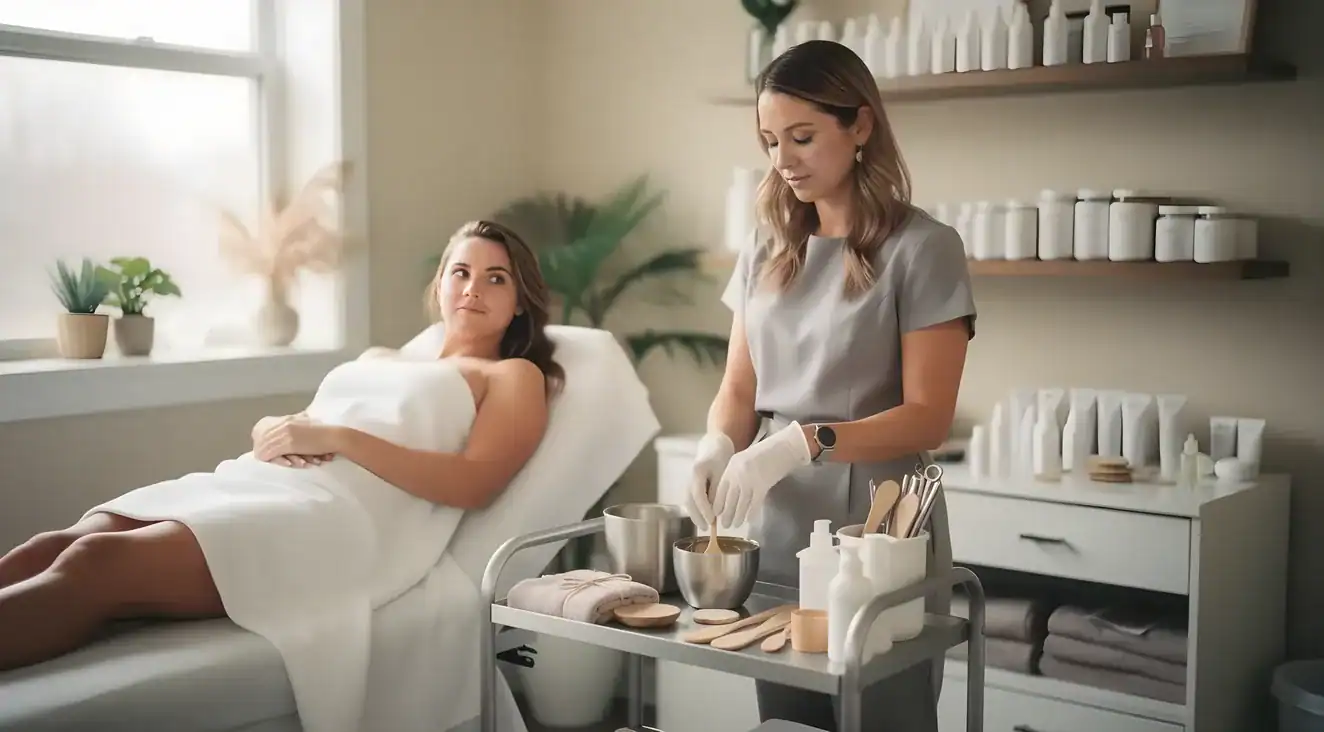
Esthetics school teaches you how to wax. It does not teach you how to run a room on solo income, set a price that covers your actual costs, or convert a single Brazilian client into 13 appointments a year. Those are business-operations skills, and they determine whether a suite-based waxing practice stays financially sustainable or limps along. This guide covers the three pillars of a solo waxing practice in a private salon suite: setting up your wax room for efficiency and compliance, pricing your services as an independent operator, and building a repeat-client book that rebooking drives.
Room configuration determines TDLR inspection compliance, client turnover speed, and whether each reset runs under ten minutes or over twenty. How the room is configured also shapes whether clients feel the calm, professional experience that keeps them coming back. Getting the waxing room setup right before your first appointment saves you from fixing problems mid-schedule.
A compliant waxing room sanitation station is a TDLR regulatory requirement, not an optional upgrade. Under the Texas Department of Licensing and Regulation (TDLR) Barbering and Cosmetology Health and Safety Rules, Rule 83.105(d) governs wax pot hygiene, including the prohibition on reusing wax or leaving applicators standing in the pot. A compliant sanitation station includes:
The cardinal rule in waxing sanitation is no double-dipping. A used applicator reinserted into a wax pot warmer contaminates the entire wax supply. The contamination risk is bacterial transmission through compromised hair follicles, which are open and exposed during every wax service. A state board violation for double-dipping carries fines of several thousand dollars and can result in license action. One applicator, one client, one service: that standard is non-negotiable regardless of schedule pressure.
The No-Double-Dipping Rule
One applicator per client, per service. A used spatula reinserted into a wax pot contaminates the entire supply. TDLR violations for double-dipping carry fines of several thousand dollars and can result in license action. No exception, regardless of schedule pressure.
In a private suite, the sanitation station belongs in a fixed, accessible position because the waxing specialist works alone. Without a second pair of hands, every supply must be reachable from the treatment bed. Place the lidded receptacle within arm’s reach of the table surface. Place the disinfectant wipes within reach of the table edge. That physical layout converts the reset sequence from a search into a motion habit.
Waxing room turnover time directly determines how many billable appointments a specialist can complete per day. A 20-minute reset between a 30-minute Brazilian appointment cuts effective service capacity in half. Waxing specialists who build profitable schedules treat turnover as a timed discipline.
A complete waxing room reset runs in this order:
The principle that compresses this sequence is pre-staging. Pulling applicators, cutting strips, and setting out products before each appointment removes those steps from the reset window entirely. Specialists who pre-stage routinely complete their full room resets in five to eight minutes. Those who do not can spend fifteen or more between clients.
Pre-Stage Before Each Appointment
Pull applicators, cut strips, and set out your pre-wax and post-wax products before the appointment starts, not during the reset. Specialists who pre-stage routinely complete full room resets in five to eight minutes.
In a private suite, the specialist controls the entire room layout. That structural advantage separates the suite model from an open-floor salon or shared wax bar. The rolling cart goes where it works for the specialist’s body mechanics. Hard wax and soft wax pot warmers are positioned to match how the specialist moves through each service type. Consumables are stocked to the specialist’s volume, not a salon manager’s shared estimate. No one else is in this room. Configure it for your workflow.
A waxing specialist renting a private suite keeps 100 percent of service revenue instead of splitting a commission, and that financial shift makes setting the right price from day one the single most important waxing business decision they will make.
In a commission salon, the salon owner sets the service menu and the specialist earns a percentage. In a suite, the independent waxing specialist sets the menu. That is pricing freedom, and it comes paired with pricing responsibility: every cost in the operation runs through the specialist’s invoice, not an employer’s.
The cost categories a solo waxing specialist must cover before calculating a profit margin include: suite rent, consumables per service (hard wax or soft wax supply, wooden applicators, muslin strips and pellon strips, gloves, pre-wax cleanser, post-wax soothing product), professional liability insurance, an online booking system, continuing education, and self-employment taxes. Self-employment tax is the most commonly overlooked cost for first-year suite renters. At 15.3 percent federal, it represents a meaningful reduction in net revenue that commission employees never experienced directly because the employer paid the employer’s half.
The most common pricing error is setting rates by copying competitor menus. A competitor’s published price reveals nothing about their cost structure or their margins. If they are underpriced relative to their actual costs, copying their rate inherits their margin problem. Pricing for an independent waxing specialist must start with what it costs to deliver the service, not what another practitioner is charging.
Start With Your Costs, Not a Competitor’s Menu
A competitor’s published rate tells you nothing about their margins. Set your floor by calculating what it actually costs to deliver each service: suite rent, consumables, self-employment taxes, insurance. That number is your starting point. What they charge is irrelevant until your costs are covered.
Service efficiency compounds earnings: a Brazilian that runs 15 minutes generates twice the hourly revenue of one that runs 30 minutes at the same price. Waxing specialists who develop genuine efficiency through technique skill (not by rushing or skipping sanitation steps) raise their earning ceiling without adding appointment slots.
For rate adjustments over time: incremental increases of a few dollars, with 30 days advance notice for existing clients, absorb without friction far more often than large jumps. Present new rates to new clients as the standing menu. They have no prior reference point. The rates are not going up for them; those are simply the rates.
A waxing service menu naturally carries multiple price tiers. Facial waxing services (brow wax, upper lip wax, chin wax) command different rates than body waxing services (leg wax, arm wax, back wax), which sit at a different level than Brazilian and bikini waxing. Combination services, such as brow plus lip or bikini plus half-leg, create a bundle layer that increases average ticket without requiring additional appointment slots on the schedule.
Because waxing removes hair at the root and the follicle cycles back to visible growth in roughly four to six weeks, a waxing specialist who books the next appointment before the client leaves the room converts a one-time visit into a 13-appointment annual relationship.
That number compounds. A single consistent Brazilian client booked on a four-week cycle generates approximately 13 appointments per year. A client book of 30 consistently rebooking clients produces a predictable, stable calendar. The hair growth cycle creates natural rebooking pressure for every waxing service type. The specialist’s job is to channel it into a confirmed appointment before the client walks out.
Waxing’s Built-In Rebooking Cycle
Hair grows back on a biological schedule. A Brazilian client on a four-week cycle books approximately 13 appointments per year without any additional marketing. Rebook the specific date before the client leaves the room. “About a month” puts off the decision. A date on the calendar locks it in.
Rebooking intervals by waxing service type:
| Service | Recommended Interval |
|---|---|
| Brazilian / bikini waxing | Every 4-6 weeks (4 weeks for new clients synchronizing the hair growth cycle) |
| Brow wax | Every 2-4 weeks |
| Upper lip / chin wax | Every 3-4 weeks |
| Leg wax / body waxing | Every 4-6 weeks |
The four-week starting interval for Brazilian clients is not arbitrary. Waxing is most effective during the anagen phase, when the hair is actively growing and still connected to the follicle. Consistent four-week appointments align with that cycle, which is why regular waxers gradually see finer, slower regrowth over time.
The most effective rebooking moment is immediately after the service, while the client is still in the room and experiencing the result. A natural cue sounds like: “You will want to come back in about four weeks. That would put us at [specific date]. Want to lock that in now?” The specific date matters. “About a month” puts the decision off. A specific date converts into a committed appointment. Clients who rebook before leaving the room rebook at far higher rates than clients who receive a follow-up reminder a week later.
Client retention beyond scheduling depends on three variables.
The first is result quality. Hair removed at the root lasts longer and grows back finer over time. Hair that breaks above the root, from incorrect wax temperature, wrong wax type, or poor application angle, grows back stubbly and quickly. Clients who experience breakage lose the primary motivation to return on schedule. Technique quality is a direct retention variable for every waxing service.
The second is comfort. Pain is the most commonly cited barrier to consistent Brazilian and bikini waxing. Hard wax grips the hair shaft without adhering to the surrounding skin, which reduces the traction force applied during removal, lowers perceived pain, and increases rebooking rates for intimate waxing services. Clients who find a specialist who makes the service genuinely tolerable do not go looking for alternatives.
The third is consistency of experience. For Brazilian and bikini waxing clients especially, privacy is the condition under which many clients will book at all, not a comfort upgrade. A private waxing suite eliminates the ambient noise, visible foot traffic, and stranger proximity of an open-floor wax bar. The client hears one voice. The music, the lighting, and the conversation are all within the specialist’s control. That controlled environment produces the trust that turns a first appointment into a standing reservation.
The post-wax moment is also the highest-conversion point for a service add-on or retail recommendation. Ingrown hairs are the most common client complaint after Brazilian and bikini waxing. A waxing specialist who addresses that proactively by recommending or retailing an ingrown hair prevention serum is solving a stated client problem, not upselling. After a brow wax, a brow tint requires minimal additional time and meaningfully increases the appointment value. Add-ons that address what the client just mentioned, right after the service, convert at rates that standalone promotional offers cannot match.
For client loyalty structure: programs that reward consistent rebooking intervals (priority scheduling after a year of regular appointments, a complimentary add-on on a service anniversary) reinforce the behavior that matters. A punch card for ten visits rewards transaction counting. It does not reward the four-week rebooking habit that builds a stable waxing schedule.
The salon suite model eliminates commercial lease negotiation and buildout costs while giving the specialist full revenue ownership from the first client. There is no hiring overhead from day one. An independent waxing specialist walks into a private room and runs the practice.
Waxing has one of the smallest equipment footprints of any esthetics service, which makes the suite model particularly practical for this vertical. The core waxing room setup is: an adjustable treatment bed, one or two wax pot warmers running simultaneously (most waxing menus use hard wax for intimate area and facial services and soft wax for larger body areas), a rolling cart for consumables and supplies, a mirror for brow wax clients to review results, and a sanitation station. No plumbing upgrade. No specialized electrical. The room turns over between independent professionals without facility-level changes.
For Parker Salons, the suite model is the environment where the operational pillars covered in this guide become executable. A waxing specialist renting a private waxing suite in Plano keeps 100 percent of their service revenue, controls their schedule, and manages the full client relationship from a room that functions exactly as described: sanitation station placed for their workflow, wax pots positioned for their technique, reset sequence calibrated for their schedule.
The private waxing room is not a nice-to-have. It is the product. The retention advantages described in the rebooking section depend on it. Clients who need privacy to feel comfortable with intimate waxing services choose a suite-based waxing specialist over a franchise wax bar because that experience cannot be replicated on an open floor.
Efficient room turnover creates scheduling capacity. Cost-covering pricing converts that capacity into margin. Systematic rebooking fills the calendar with recurring appointments rather than one-time visits. Each pillar reinforces the others.
None of these requires a large client list. A suite-based waxing practice with 30 to 40 rebooking clients, priced to cover full costs, can sustain a full schedule without the client volume a commission salon requires. That is the math available to an independent waxing professional working from a private suite sized and configured for solo esthetic work.
Looking for a waxing suite in Plano? Call (469) 467-8081 or visit the suites page.
Waxing is among the higher-margin personal care services because consumable cost per service is relatively low and the repeat-business cycle is biologically built in through the hair growth cycle. A solo waxing specialist who prices to cover real costs, including suite rent, consumables per service, self-employment taxes, and professional liability insurance, and who maintains a strong rebooking rate, can build a stable, predictable income from a client list that would seem small in a commission-based environment. Income varies based on local market rates, waxing service mix, appointment volume, and pricing structure. A suite-based waxing specialist who fills their schedule consistently with recurring Brazilian, bikini, brow, and body waxing clients lands toward the higher end of the solo esthetician income range relative to gross revenue per appointment.
Technique errors are the most direct cause of client loss: double-dipping, wax applied at an incorrect temperature, and hair breaking above the root rather than being removed cleanly at the follicle. Each of these produces an inferior result that undermines the client’s reason to maintain a schedule. On the business side, the most common mistakes are pricing based on competitor menus without knowing your own cost structure, failing to rebook the client before they leave the room, and not addressing the most predictable post-service concern (ingrown hair) before the client brings it up. A private waxing suite supports better outcomes on the technique side by providing consistent, controlled conditions for every appointment.
Waxing service type determines the interval. Brazilian and bikini waxing clients typically return every four to six weeks, with four weeks being the recommended starting interval for new clients who are synchronizing their hair growth cycle for the first time. Regular waxers on a consistent schedule often find hair grows back finer and slower over time. Brow waxing runs every two to four weeks depending on growth rate and desired shape maintenance. Upper lip and chin waxing typically runs three to four weeks. Leg wax and body waxing falls in the four-to-six-week range. Booking the specific next-appointment date before the client leaves the room captures that rebooking window reliably.
Start with the treatment surface: an adjustable waxing table is the center of the room. From there, add one or two wax pot warmers (running hard wax and soft wax simultaneously covers the full service menu), a rolling cart stocked with applicators and consumables, and a mirror positioned for brow wax clients. The sanitation station requires an EPA-registered disinfectant with tuberculocidal rating, a fresh glove supply, a lidded trash receptacle, and dedicated clean applicator storage. Consumables per service include large and small wooden applicators, muslin strips and pellon strips for soft wax, disposable gloves, pre-wax cleanser, post-wax soothing product, and disposable bed covers. The total setup fits comfortably in a private salon suite without specialized plumbing or electrical upgrades.
Standard waxing contraindications include clients currently using retinoids or retinoic acid (including prescription tretinoin and isotretinoin), which significantly increase skin fragility and tearing risk; active sunburn in the service area; open sores or active skin infections; and certain medications that thin the skin or increase photosensitivity, including some blood thinners and antibiotics. A brief pre-service intake consultation to screen for contraindications is standard professional practice: it protects the client from an adverse outcome and protects the waxing specialist from liability for a service that should not have been performed. Frame the intake as routine procedure, not an obstacle. Most clients appreciate that a specialist takes a moment to check before starting.
The 5 S’s of waxing are a professional framework for safe, effective service delivery: Skin (cleanse and assess the treatment area before application), Strip (apply and remove wax correctly for the service type), Speed (remove the strip or hard wax in one fast, low-angle pull to minimize trauma), Soothe (apply a post-wax calming product immediately after removal to reduce redness and sensitivity), and Sanitize (disinfect all surfaces and discard single-use items between every client). The framework exists because each step prevents a specific failure: skipping skin prep leads to lifting and irritation, slow removal causes bruising, and skipping sanitation creates cross-contamination risk.
The 48-hour rule is post-wax aftercare guidance: clients should avoid heat, friction, and irritants on the waxed area for 48 hours after the service. That means no hot showers, saunas, or steam rooms; no sun exposure or tanning; no heavy exercise that causes sweating; no tight clothing on the treated area; and no exfoliants, fragranced products, or active ingredients (such as retinoids or glycolic acid) on freshly waxed skin. Hair follicles remain open and vulnerable immediately after waxing, and any of those exposures can trigger irritation, ingrown hairs, or infection. Waxing specialists who communicate this clearly at checkout reduce post-service complaints and support better rebooking outcomes.